
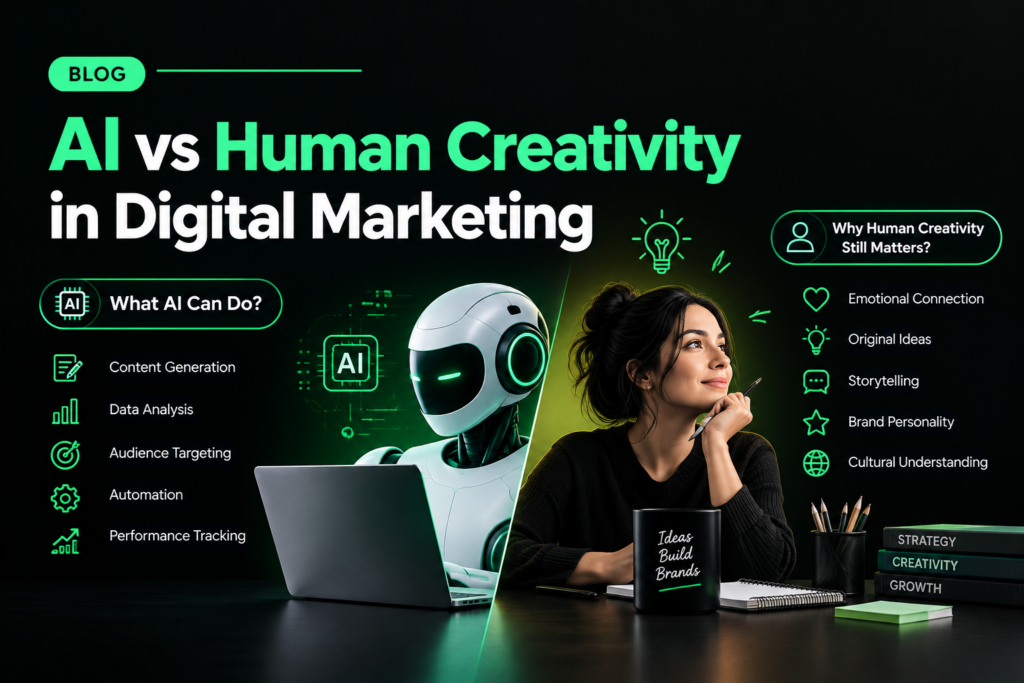
AI vs Human Creativity in Digital Marketing: Finding the Right Balance
Digital marketing is changing faster than ever.
Artificial intelligence (AI) has become a useful part of the way marketers create content, understand audiences, analyze data, and manage campaigns. With the help of AI marketing tools, many tasks that once took hours can now be completed in a few minutes.
But does that mean AI can replace human creativity?
Not really.
AI can help marketers work faster and smarter, but creativity, emotions, personal experience, and human understanding still play an important role in successful digital marketing. AI and Human Creativity in Digital Marketing can work together to create marketing that is both efficient and meaningful. The real advantage comes from knowing how to use AI in digital marketing without losing the human side of marketing.
What Is AI in Digital Marketing?
AI in digital marketing means using artificial intelligence tools and technologies to make marketing tasks faster, more efficient, and data-driven.
Today, artificial intelligence in marketing is being used for content creation, customer analysis, advertising, SEO, social media marketing, email marketing, and many other areas.
For example, a marketer can use AI to generate content ideas, analyze campaign performance, find audience patterns, or create different versions of an advertisement.
AI is becoming a helpful assistant for digital marketers rather than simply being another technology. As AI-powered digital marketing continues to develop, the relationship between technology and creativity is becoming more important.
This is why AI and Human Creativity in Digital Marketing is an important topic for modern marketers who want to use technology while keeping their content authentic and engaging.
What Can AI and Human Creativity in Digital Marketing Do Together?
AI can support marketers in many different ways, while human creativity helps turn those capabilities into meaningful marketing.
The real value of AI and Human Creativity in Digital Marketing comes from combining the strengths of both. AI can handle data, automation, and repetitive work, while human marketers can focus on ideas, emotions, strategy, and communication.
1. AI and Human Creativity in Digital Marketing for Content Creation
AI marketing tools can help generate blog ideas, captions, headlines, product descriptions, email drafts, and social media content.
This can save time, especially when a marketer needs to create content regularly.
However, AI-generated content still needs human editing to make it natural, relevant, and suitable for the target audience.
A marketer can use AI to create an initial idea and then add personal experience, brand personality, and creative thinking. This is one of the clearest examples of AI and Human Creativity in Digital Marketing working together.
2. Audience Analysis
Understanding the audience is one of the most important parts of digital marketing.
AI can analyze large amounts of data and identify patterns in customer behavior. It can help marketers understand what people are searching for, what content they interact with, and what type of products or services may interest them.
This allows marketers to make better decisions based on data and build a more effective AI marketing strategy.
However, data alone cannot explain every reason behind customer behavior. Human understanding is still important when interpreting the information and deciding how to communicate with the audience.
This balance is an important part of AI and Human Creativity in Digital Marketing, because useful data becomes more valuable when a marketer knows how to apply it creatively.
3. Personalized Marketing
People respond better to content that feels relevant to them.
AI can help businesses personalize emails, advertisements, product recommendations, and other marketing messages based on customer behavior and interests.
For example, an online store can recommend products based on what a customer previously viewed or purchased.
Human marketers can then make sure these personalized messages still feel natural and appropriate for the brand.
4. Social Media Marketing
AI can also support social media marketing by helping with content ideas, captions, scheduling, audience insights, and performance analysis.
Instead of spending too much time on repetitive tasks, marketers can use that saved time to focus on strategy and creativity.
This shows how digital marketing with AI can support marketers while still keeping human decision-making at the center.
The combination of AI tools and human creativity can help create social media content that is both efficient and relatable.
In AI and Human Creativity in Digital Marketing, technology can reduce repetitive work while marketers can spend more time developing original content and meaningful communication.
5. Advertising
AI is becoming increasingly useful in digital advertising.
It can analyze campaign data, identify high-performing audiences, test different advertisements, and help marketers optimize campaigns.
This can make paid advertising more efficient and data-driven while helping marketers understand which strategies are working.
However, human marketers still need to decide the message, creative direction, brand tone, and overall advertising strategy.
6. SEO and Search Optimization
AI tools can help marketers with keyword research, content ideas, competitor analysis, and search intent.
AI-powered search is also changing the way people discover information online. Because of this, marketers need to think beyond traditional SEO and focus on creating useful, clear, and trustworthy content.
As search continues to evolve, combining SEO with AI in digital marketing can help marketers adapt to changing user behavior.
This is another area where AI and Human Creativity in Digital Marketing can support each other by combining technology with human understanding.
Why Is Human Creativity Important in AI and Human Creativity in Digital Marketing?
Even with all these AI capabilities, marketing is not only about data.
People connect with stories, emotions, experiences, and ideas.
This is where human creativity in digital marketing becomes important. AI and Human Creativity in Digital Marketing bring different strengths to the marketing process.
AI can process information and identify patterns, while humans can bring emotions, imagination, experience, and original thinking.
The balance between these two strengths is an important part of modern marketing.
1. Humans Understand Emotions
AI can analyze data, but humans experience emotions.
A good marketing message is not always successful because it contains the right keywords. Sometimes it works because it makes people feel something.
A story that creates happiness, trust, excitement, or curiosity can make a stronger connection with an audience.
Understanding those emotions requires human thinking and experience. This makes human creativity an important part of AI and Human Creativity in Digital Marketing.
2. Creativity Goes Beyond Patterns
AI learns from existing information and patterns. It can generate many ideas based on what it has learned.
But human creativity can come from personal experiences, imagination, unexpected ideas, and real-life situations.
A human marketer can look at a problem differently and create an idea that feels fresh and unique.
This ability to think differently gives AI and Human Creativity in Digital Marketing an important human element that technology alone cannot provide.
3. Brand Personality Needs a Human Touch
Every brand has its own personality.
Some brands are friendly and casual. Others are professional, luxurious, playful, or inspirational.
Human marketers understand how a brand should communicate with its audience and can make sure the content feels authentic.
AI can help write the message, but humans decide how the brand should sound.
A strong brand voice is therefore another important part of AI and Human Creativity in Digital Marketing.
4. Humans Understand Context
The same message may not work for every audience.
A campaign that works for one business may fail for another because the audience, culture, location, product, and customer expectations are different.
Human marketers can understand these details and adjust the strategy accordingly.
AI can provide useful information, but human judgment helps marketers apply that information to the right situation.
This human judgment is especially important when applying AI and Human Creativity in Digital Marketing to different brands and audiences.
5. Storytelling Still Matters
People remember stories more easily than plain information.
A good digital marketing campaign often has a story behind it.
Whether it is a social media post, video advertisement, website content, or brand campaign, storytelling can make the message more memorable.
AI can assist with writing a story, but the human experience behind that story is what gives it meaning.
This shows why AI and Human Creativity in Digital Marketing is not simply about using technology. It is also about creating meaningful communication.
AI vs Human Creativity in Digital Marketing: How Can They Work Together?
The better question is not whether AI or humans are better.
The better question is:
How can AI and human creativity work together?
AI is excellent at speed, data processing, automation, and repetitive tasks.
Humans are strong at creativity, emotions, strategy, judgment, storytelling, and understanding people.
When these strengths are combined, digital marketing can become more effective. This is why AI and Human Creativity in Digital Marketing can be viewed as complementary rather than competing approaches.
| AI | Human Creativity |
|---|---|
| Works quickly | Thinks creatively |
| Analyzes large amounts of data | Understands emotions |
| Automates repetitive tasks | Builds authentic connections |
| Finds patterns | Creates unique ideas |
| Supports personalization | Understands context |
| Generates content ideas | Adds personal experience |
| Helps optimize campaigns | Makes strategic decisions |
The comparison between AI and human creativity shows that both can contribute differently to the marketing process. AI and Human Creativity in Digital Marketing becomes more effective when these different strengths are used together.
The Best Approach to AI and Human Creativity in Digital Marketing
A successful digital marketer does not have to choose between AI and creativity.
Instead, AI can be used as a tool that supports human work.
For example, a marketer can use AI to generate ten content ideas. Instead of publishing them directly, the marketer can select the best idea, add personal experience, understand the audience, improve the message, and give it a unique brand voice.
This creates content that is both efficient and human.
F.A.Q.
AI VS HUMAN CREATIVITY
AI can analyze data, generate ideas, and automate repetitive marketing tasks, while human creativity adds emotions, originality, storytelling, and personal experience. AI vs Human Creativity shows how these two approaches have different strengths. Understanding AI vs Human Creativity can help marketers use technology while maintaining a human touch.
AI can support many creative tasks, but human creativity is still important for understanding emotions, brand personality, context, and audience needs. AI vs Human Creativity highlights the different roles of technology and human thinking in marketing. The discussion around AI vs Human Creativity is more about collaboration than completely replacing human creativity.
AI can generate content ideas, headlines, captions, and drafts quickly, helping marketers save time and explore different possibilities. AI vs Human Creativity shows how AI can support the creative process while humans add personal experience and original ideas. With AI vs Human Creativity, marketers can combine AI-powered efficiency with human creative thinking.
AI and human creativity have different strengths. AI is useful for data analysis, automation, and generating ideas, while humans are important for strategy, emotions, storytelling, and original thinking. AI vs Human Creativity is therefore not simply about choosing one over the other. Understanding AI vs Human Creativity can help marketers use both effectively.
The future of AI vs Human Creativity will involve greater collaboration between AI tools and human marketers. AI can handle repetitive and data-heavy tasks, while marketers can focus on creativity, strategy, storytelling, and audience connections. As technology develops, AI vs Human Creativity will remain an important topic in the future of digital marketing.
Human creativity helps brands communicate emotions, tell stories, understand audiences, and create unique brand identities. AI vs Human Creativity highlights why human emotions and original thinking are still important in digital marketing. The human side of AI vs Human Creativity helps make marketing content more authentic and relatable.
AI can help with data analysis, content ideas, and repetitive marketing tasks, while humans can add creativity, emotions, and strategic thinking. AI vs Human Creativity shows how both can complement each other. By understanding AI vs Human Creativity, marketers can create content that is both efficient and engaging.
AI vs Human Creativity is important because AI is becoming a common part of digital marketing. While AI can improve speed and productivity, human creativity helps brands create original ideas and emotional connections. Understanding AI vs Human Creativity can help marketers maintain a balance between technology and creativity.
AI can generate content, ideas, and creative suggestions, but human marketers can add personal experience, emotions, context, and originality. AI vs Human Creativity highlights these differences in the creative process. The relationship between AI vs Human Creativity can help marketers use AI-generated content while maintaining a human touch.