
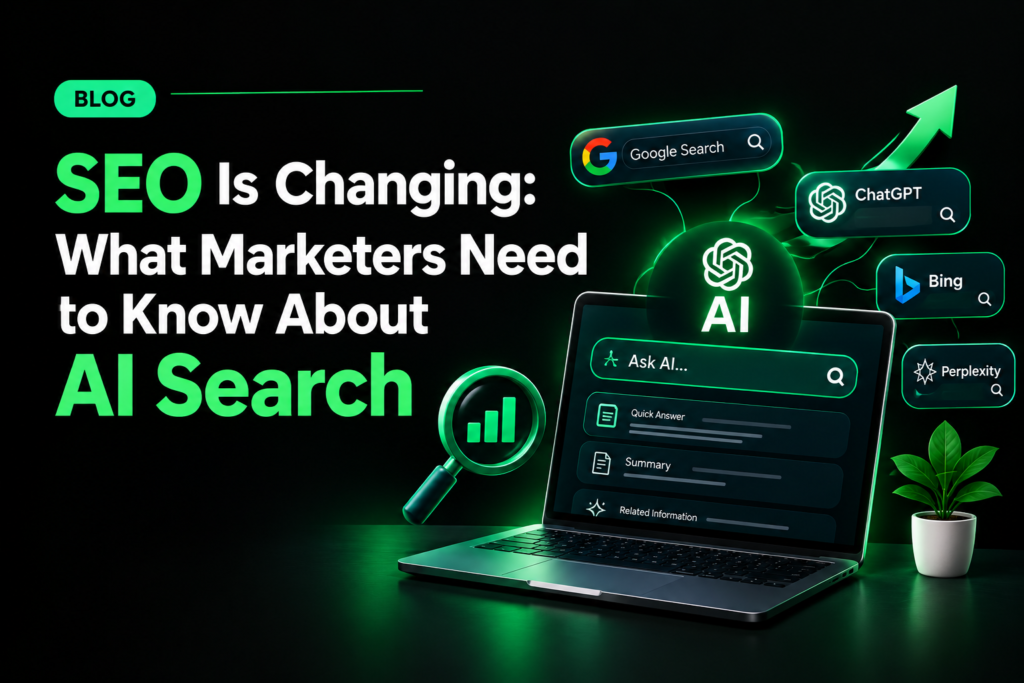
The way people search for information online is changing faster than ever.AI in future SEO
:
Search is becoming more conversational as people ask complete questions instead of short keywords. AI-powered search is also changing how users discover information and brands.
This shift is shaping AI in future SEO, where search optimization focuses more on user intent, useful answers, and AI-powered search experiences.
This has made AEO (Answer Engine Optimization) an important part of modern digital marketing. AEO does not replace SEO; it adds another layer by helping content provide clear answers to users’ questions.
How Is Online Search Changing?
Search behavior has moved beyond simple keyword searches.
A user might previously search:
“digital marketing services”
Now, they may ask:
“Which digital marketing services can help a small business get more customers?”
The second search gives much more context about the user’s needs and expectations.
This is why search intent is becoming important in AI in future SEO, as AI-powered search focuses more on understanding questions and providing relevant answers.
The Rise of Conversational Search
Conversational search allows users to interact with search systems more naturally by asking longer questions and providing more context.
For example:
Traditional search:
“SEO benefits”
Conversational search:
“How can SEO help a small business get more customers?”
The second query is closer to a real conversation and gives more context about the user’s needs.
This shift is important for AI in future SEO, where content needs to focus not only on keywords but also on answering real questions and solving user problems.
What Is AEO?
AEO stands for Answer Engine Optimization.
AEO is the process of creating content that clearly answers questions users are asking through search engines, answer engines, voice assistants, and AI-powered search experiences.
Traditional SEO often focuses on improving webpage visibility.
AEO focuses on making information easy to understand, identify, and use as an answer.
The goal is simple:
Create content that gives people the information they need in a clear and useful way.
Why Is AEO Important for Digital Marketing?
People want answers quickly.
They don’t always want to read five different articles before finding a simple explanation.
AI-powered search experiences are making this even more noticeable by providing summarized responses and conversational answers.
For businesses, this creates a new opportunity.
A brand that consistently publishes useful, accurate, and well-structured content can improve its overall online visibility and brand authority.
AEO therefore becomes part of a broader digital marketing strategy.
SEO and AEO: Are They the Same?
No. SEO and AEO have different focuses, but they work well together. As AI in future SEO continues to develop, both approaches are becoming important for modern search optimization.
Understanding AI in future SEO also helps marketers adapt to changing search behavior, where users expect more direct and relevant answers.
With AI in future SEO, traditional SEO remains important while AEO adds a stronger focus on answering user questions clearly and effectively.
What Does SEO Focus On?
SEO (Search Engine Optimization) focuses on improving a website’s visibility in traditional search results. In AI in future SEO, traditional SEO practices still provide an important foundation for helping search engines understand and discover website content.
Important SEO areas include:
-
Keyword research
-
On-page SEO
-
Technical SEO
-
Website performance
-
Internal linking
-
Quality backlinks
-
Content optimization
-
Search intent
These practices can support better search visibility while preparing websites for the changing search environment shaped by AI in future SEO.
What Does AEO Focus On? AEO focuses on answering specific questions clearly.
Important AEO areas include:
-
- Question-based content
-
- Direct answers
-
- Search intent
-
- FAQs
-
- Conversational queries
-
- Clear content structure
-
- Useful and relevant information
The best strategy is not to choose one over the other.
SEO helps people find your content, while AEO helps your content answer their questions.
Why Search Intent Matters in AEO
Search intent means understanding the reason behind a search.
Consider these three searches:
“What is social media marketing?”
The user wants information.
“Best social media marketing tools”
The user is comparing options.
“Social media marketing agency”
The user may be looking for a service.
Although all three searches are related to social media marketing, their intentions are different.
Understanding this difference helps marketers create content that matches the user’s actual needs.
How AI Understands User Questions
AI-powered search systems can understand the context behind a question instead of looking only at individual keywords.
For example, if someone asks:
“How can I promote my new clothing business online?”
the search system can understand that the user may be interested in areas such as social media marketing, paid advertising, content marketing, influencer marketing, SEO, and online branding.
This means marketers should create content around topics and concepts, not just individual keywords.
How Can Your Brand Appear in AI Answers?
There is no guaranteed method for getting a brand included in an AI-generated answer.
However, businesses can strengthen their online presence by creating content that is:
-
- Helpful
-
- Accurate
-
- Relevant
-
- Original
-
- Well-structured
-
- Easy to understand
-
- Consistently updated
A strong content strategy can help search systems better understand what a business does and what topics it has expertise in.
Create Content Around Real Questions
One of the easiest ways to start with AEO is to identify questions your customers commonly ask.
For a digital marketing website, these could include:
-
- What is digital marketing?
-
- How does SEO work?
-
- Why is social media marketing important?
-
- How can Instagram help a business?
-
- What is AEO?
-
- What is GEO?
-
- How can a business increase website traffic?
-
- How can digital marketing increase sales?
Each question can become a blog topic, FAQ, or dedicated section of a service page.
Use Question-Based Headings
Question-based headings make content easier to scan.
For example:
Instead of:
Benefits of SEO
use:
Why Is SEO Important for Businesses?
Instead of:
AEO Strategy
use:
How Can Businesses Improve Their AEO Strategy?
Instead of:
AI Search
use:
How Is AI Changing Online Search?
These headings naturally reflect the way people ask questions.
The Role of FAQs in AEO
FAQs are particularly useful for answering common customer questions.
A well-written FAQ section can address doubts that users may have before choosing a product or service.
For example:
What is AEO?
AEO is the process of optimizing content to provide clear answers to user questions across search and answer-focused experiences.
Is AEO replacing SEO?
No. AEO complements SEO by focusing more strongly on direct answers and conversational search.
Why should businesses care about AEO?
Because search behavior is changing, and users are increasingly looking for quick, direct, and useful answers.
The key is to provide genuine answers rather than creating FAQs only for search engines.
Why Long-Tail Keywords Matter
Long-tail keywords are longer and more specific search phrases.
For example:
Short keyword:
“SEO”
Long-tail keyword:
“How can SEO help a small business increase website traffic?”
Long-tail searches often reveal stronger search intent.
They can also give businesses opportunities to create highly focused content that directly addresses specific customer needs.
AEO and Voice Search
Voice search has also encouraged more conversational queries.
When people speak to a device, they tend to ask questions naturally.
For example:
“What are the best digital marketing strategies for a small business?”
This is different from typing:
“digital marketing strategies small business.”
AEO-friendly content can therefore be useful for businesses targeting conversational and voice-based search behavior.
How Local Businesses Can Benefit From AEO
AEO is not only useful for large companies.
Local businesses can also create content around questions their customers frequently ask.
For example, a local digital marketer could create content answering:
-
- What digital marketing services are available for small businesses?
-
- How can local businesses improve their online presence?
-
- How can Instagram marketing help local brands?
-
- Why is local SEO important?
Creating locally relevant and useful content can help businesses build stronger online visibility.
AEO for Service-Based Businesses
Service businesses can use AEO to answer questions before customers contact them.
For example, a web development business could answer:
“How much does it cost to build a business website?”
A social media marketer could answer:
“How can social media marketing increase brand awareness?”
A digital marketing professional could answer:
“Which digital marketing strategy is best for a small business?”
These answers can educate potential customers while also demonstrating expertise.
What Makes Content AEO-Friendly?
AEO-friendly content does not need to follow a complicated formula.
Good content should have:
Clear Structure
Use logical headings and subheadings.
Direct Answers
Answer questions clearly before adding additional details.
Useful Information
Focus on solving a real problem.
Natural Keywords
Use relevant SEO keywords without forcing them into every paragraph.
Readable Formatting
Use short paragraphs, bullet points, examples, and FAQs where appropriate.
Original Value
Add your own insights, examples, experience, or perspective.
Why Original Content Matters
AI can generate information quickly, but simply publishing generic AI-generated content does not automatically create authority.
People want content that provides something useful beyond information that can be found everywhere.
Original examples, practical experiences, unique opinions, case studies, and expert insights can make content more valuable.
This is where human expertise becomes important.
AI can help create content faster, but human experience can make that content more meaningful.
AEO, SEO and GEO: What Is the Difference?
Modern search optimization includes several related concepts.
SEO
Focuses on visibility in traditional search engines.
AEO
Focuses on providing clear answers to user questions.
GEO
Generative Engine Optimization focuses on improving the visibility and representation of content and brands within generative AI search experiences.
These strategies can work together rather than being treated as separate marketing activities.
A modern content strategy can therefore focus on:
SEO for discovery + AEO for answers + GEO for AI search visibility.
How Social Media Can Support AEO
AEO is mainly associated with search, but social media can also support a brand’s overall online presence.
Businesses can create:
-
- Educational Instagram posts
-
- LinkedIn articles
-
- YouTube videos
-
- Short-form videos
-
- FAQ posts
-
- Question-and-answer content
When the same expertise is consistently communicated across different platforms, it can strengthen brand recognition and authority.
Common AEO Mistakes to Avoid
AEO is not about trying to trick search engines or AI systems.
Some common mistakes include:
Keyword Stuffing
Repeating the same keyword unnecessarily can make content difficult to read.
Writing Only for Search Engines
Content should always provide value to real people.
Creating Generic Answers
Short answers without useful context may not satisfy the user’s needs.
Ignoring Search Intent
A keyword alone does not tell you what the user actually wants.
Publishing Outdated Information
Search and digital marketing continue to evolve, so important content should be reviewed and updated.
How to Optimize Your Website for AEO
Businesses can start with simple improvements.
Step 1: Find Common Questions
Use customer conversations, social media comments, forums, and keyword research to identify real questions.
Step 2: Create Helpful Content
Write articles and pages that answer those questions.
Step 3: Improve Your Existing Pages
Add FAQs, explanations, examples, and useful information to important website pages.
Step 4: Organize Your Content
Use clear headings, subheadings, lists, and short paragraphs.
Step 5: Keep Information Updated
Review important content regularly and update outdated information.
How to Measure AEO Success
AEO success may not always look exactly like traditional SEO success.
Marketers can monitor:
-
- Organic search traffic
-
- Search visibility
-
- Website impressions
-
- Click-through rate
-
- Featured search results
-
- Brand mentions
-
- Referral traffic
-
- Engagement
-
- Leads and conversions
The goal is not simply to appear somewhere in search.
The goal is to attract the right audience and provide useful information that supports the customer journey.
The Future of Search Marketing
Search will continue to evolve.
Traditional search engines will remain important, while AI-powered and conversational search experiences will continue to influence how people discover information.
This means marketers need to think beyond rankings.
They need to think about visibility, answers, authority, relevance, and user experience.
The brands that understand their audience and consistently provide useful information will have stronger opportunities to remain visible as search evolves.
Final Thoughts
The move from SEO to AEO is not about abandoning everything marketers already know.
It is about adapting to a new search environment.
SEO remains important for website visibility. AEO helps marketers create content that directly answers user questions. GEO adds another layer by considering how brands and information can appear within generative AI experiences.
The most effective approach is to bring these ideas together.
Understand what people are searching for. Answer their questions clearly. Create genuinely useful content. Build authority. Keep improving.
Because as search becomes more conversational, one thing becomes increasingly important:
Don’t just create content that can be found. Create content worth finding.
Frequently Asked Questions
AI in future SEO
AI in future SEO refers to how artificial intelligence is changing the way websites are optimized for search. AI can help marketers understand search intent, analyze content, identify useful keywords, and create more relevant search strategies. As AI in future SEO continues to develop, marketers will need to focus not only on keywords but also on user questions, content quality, and conversational search.
AI in future SEO will make search optimization more focused on understanding what users actually want rather than matching keywords alone. AI-powered search can understand context, longer questions, and conversational queries. This means marketers may need to create clear, useful, and well-structured content that directly answers users’ questions. Understanding AI in future SEO can help businesses adapt their SEO strategies to changing search behavior.
No. AI in future SEO is expected to support and change traditional SEO rather than completely replace it. Important SEO practices such as keyword research, technical SEO, content optimization, website performance, and search intent will continue to be useful. At the same time, AI in future SEO can help marketers analyze data, understand user behavior, and create more relevant strategies for modern search experiences
The role of AI in future SEO is to make search more intelligent, conversational, and focused on user intent. AI-powered search can better understand complete questions, context, and the information users are looking for. As AI in future SEO develops, marketers will need to focus not only on keywords but also on creating useful, clear, and relevant content. Understanding AI in future SEO can help businesses adapt their content strategies to changing search behavior.
AI in future SEO will continue to influence how people interact with search engines and AI-powered search platforms. Instead of using short keywords, users can ask detailed questions and expect direct answers. This means marketers need to create content that addresses real questions and provides useful information. With AI in future SEO, understanding search intent, conversational queries, and clear answers can become increasingly important.